Wednesday, 16 April 2014

St Bernadette


On 16 April 1879, Bernadette - or Sister Marie-Bernard, as she was known within her Order - died in the Sainte Croix (Holy Cross) Infirmary of the Convent of Saint-Gildard. She was thirty-five.

Born into a humble family which little by little fell into extreme poverty, Bernadette had always been a frail child. Quite young, she had already suffered from digestive trouble, then after having just escaped being a victim of the cholera epidemic of 1855, she experienced painful attacks of asthma, and her ill health almost caused her to be cut off for ever from the religious life. When asked by Monsignor Forcade to take Bernadette, Louise Ferrand, the Mother Superior of the Sisters of Nevers, replied: "Monsignor, she will be a pillar of the infirmary."

At least three times during her short life-time, she received the last Sacraments. She was gradually struck by other illnesses as well as asthma: among them, tuberculosis of the lung and a tubercular tumour on her rightknee. On Wednesday, 16  April 1879, her pain got much worse. Shortly after eleven she seemed almost to be suffocating and was carried to an armchair, where she sat with her feet on a footstool in front of a blazing fire. She died at about 3:15 in the afternoon.

The civil authorities permitted her body to remain on view to be venerated by the public until Saturday, April 19th. Then it was"placed in a double coffin of lead and oak which was sealed in the presence of witnesses who signed a record of the events." Among the witnesses were "inspector of the peace, Devraine, and constables Saget and Moyen."

The nuns of Saint-Gildard, with the support of the bishop of Nevers, applied to the civil authorities for permission to bury Bernadette's body in a small chapel dedicated to Saint Joseph which was within the confines of the convent. The permission was granted on 25 April 1879, and on April 30th, the local Prefect pronounced his approval of the choice of the site for burial. Immediately they set to work on preparing the vault. On 30 May 1879, Bernadette's coffin was finally transferred to the crypt of the chapel of Saint Joseph. A very simple ceremony was held to commemorate the event.
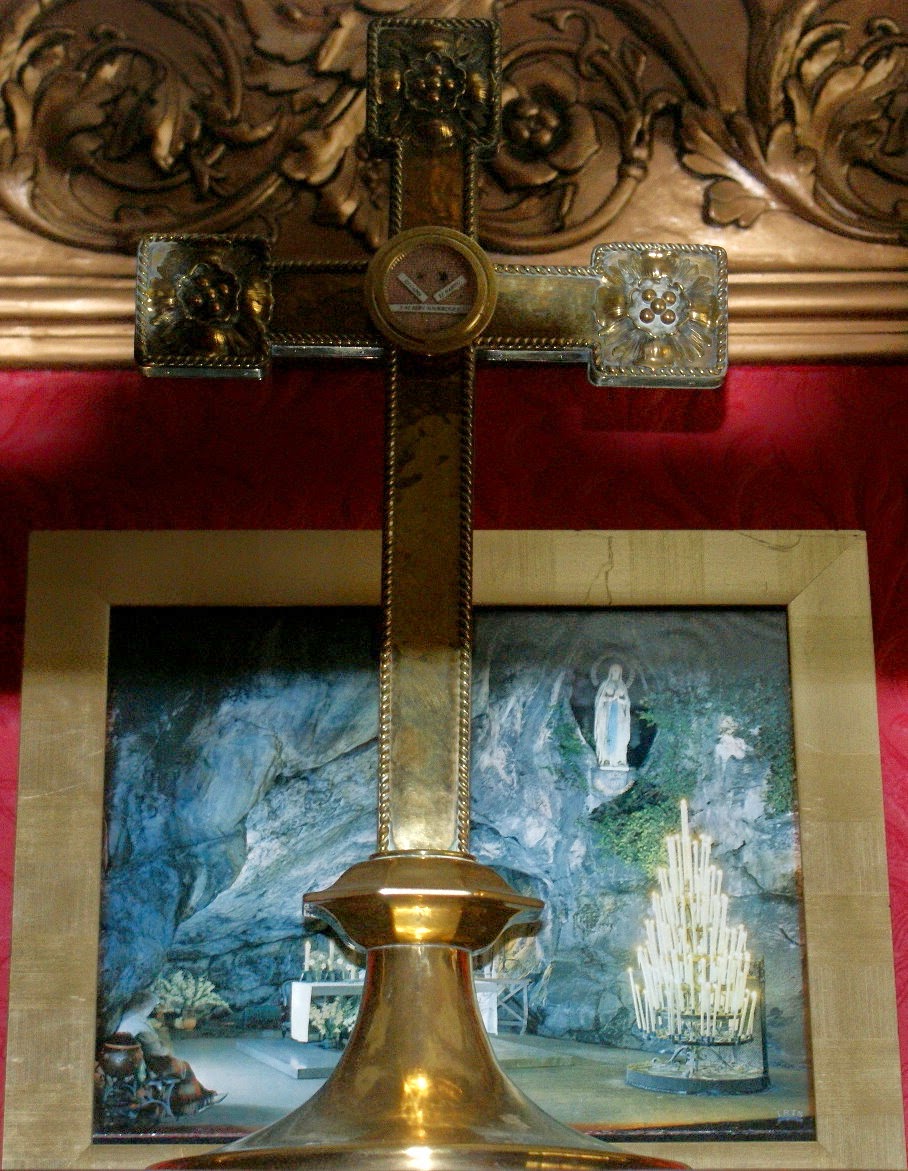


St Bernadette was born at Lourdes, France. Her parents were extremely poor and she herself was in poor health. One Thursday, 11 February 1858, when she was sent with her younger sister and a friend to gather firewood, a very beautiful Lady appeared to her above a rose bush in a grotto called Massabielle. The beautiful Apparition was dressed in blue and white. She smiled at Bernadette and then made the sign of the cross with a rosary of ivory and gold. Bernadette fell on her knees, took out her own rosary and began to pray the rosary. The beautiful Apparition was God's Mother, the Blessed Virgin Mary. She appeared to Bernadette seventeen other times and spoke with her. She told Bernadette that she should pray sinners, do penance and have a chapel built there in her honour. Many people did not believe Bernadette when she spoke of her vision. She had to suffer much. But one day Our Lady told Bernadette to dig in the mud. As she did, a spring of water began to flow. The next day it continued to grow larger and larger. Many miracles happened when people began to use this water. When Bernadette was older, she became a nun. She was always very humble. More than anything else, she desired not to be praised. Once a nun asked her if she had temptations of pride because she was favoured by the Blessed Mother. "How can I?" she answered humbly and quickly. "The Blessed Virgin chose me only because I was the most ignorant." 
Her feast day is April 16th.


Wednesday, 2 October 2013

Holy Guardian Angels


"For he hath given his angels charge over thee; to keep thee in all thy ways.” - Psalm 90: 11

"No evil shall befall you, nor shall affliction come near your tent, for to His Angels God has given command about you, that they guard you in all your ways. Upon their hands they will bear you up, lest you dash your foot against a stone" - Psalm 91: 10-12

The Catechism of the Catholic Church states: “From infancy to death human life is surrounded by their watchful care and intercession”(No. 336). St Basil asserted: “Beside each believer stands an angel protector and shepherd leading him to life. ”

The truth that each and every human soul has a Guardian Angel who protects us from spiritual and physical evil has also been shown throughout the Old Testament, and is made very clear in the New Testament.

It is written that the Lord Jesus is strengthened by an angel in the Garden of Gethsemane and that an angel delivered St Peter from prison in the Acts of the Apostles.

But Jesus makes the existence and function of guardian angels explicit when He says: "See that you despise not one of these little ones: for I say to you, that their angels in heaven always see the face of my Father who is in heaven." (Matthew 18: 10).

In saying this, Jesus points out that all people, even little children, have a guardian angel and that the angels are in Heaven, always looking at the face of God throughout their mission on earth, which is to guide us and protect us throughout our pilgrimage to the house of our Father. As St Paul says: "Are they not all ministering spirits, sent to minister for them, who shall receive the inheritance of salvation?"(Hebrews 1: 14)

However, they guide us to Heaven only if we desire it. St Thomas Aquinas wrote that angels cannot act directly upon our will or intellect, although they can do so on our senses and imaginations – thus encouraging us to make the right decisions. In Heaven our guardian angels, though no longer needing to guide us to salvation, will continue to enlighten us.

It is important to pray to your guardian angel and become friends with your angel. Ask for your guardian angel's help when you're stuck in traffic, when you need a parking place, and when you need help with your computer or the Internet. Call upon them in times of temptation or weakness and they will assist, enlighten, and protect you.

The prayer to the guardian angels has been present in the Church since at least the beginning of the 12th century.

Guardian Angel Prayer:

Angel of God, my Guardian dear, to whom God's love commits me here, ever this day be at my side, to light and guard, to rule and guide. Amen.

Guardian Angel Quotes:

"The servants of Christ are protected by invisible, rather than visible, beings. But if these guard you, they do so because they have been summoned by your prayer. "

~ St Ambrose

“Let us affectionately love His angels as counselors and defenders appointed by the Father and placed over us. They are faithful; they are prudent; they are powerful; Let us only follow them, let us remain close to them, and in the protection of the God of heaven let us abide.”

~ St Bernard of Clairvaux

"God's universal providence works through secondary causes . . . The world of pure spirits stretches between the Divine Nature and the world of human beings; because Divine Wisdom has ordained that the higher should look after the lower, Angels execute the Divine plan for human salvation: they are our Guardians, who free us when hindered and help to bring us home."

~ St Thomas Aquinas


Tuesday, 1 October 2013

St Thérèse of the Child Jesus


St Thérèse of the Child Jesus and the Holy Face was buried in the Lisieux municipal cemetery on 4 October 1897. She was the first to be buried in the new plot her monastery had purchased in response to the city's new legislative directives prohibiting interment inside the cloister. In view of what took place after St Thérèse's death, it can now be said that the new directives were providential, since they enabled hundreds of thousands of pilgrims to visit her grave over a period of twenty-five years. Had St Thérèse been buried inside the cloister, this would never have been possible. Only in 1923 on the occasion of her beatification were her mortal remains transferred to the Carmelite chapel where they are kept to this day.


When people stand in the presence of the mortal remains of St Thérèse of Lisieux, or have some contact with her relics, as with petals from an unpetalled rose, God, who received through her humanity so many signs of love, is pleased in turn to manifest his love through her bodily remains.


From these poor signs, God's salvific power reveals and unfolds itself. It is enough to read the many volumes recounting favours and cures obtained through contact with St Thérèse's relics, as well as the abundant correspondence that arrives daily in Lisieux. 


We are indeed blessed at the Holy Grail retreat to be able to display numerous first class relics of St Thérèse at a dedicated shrine created for the purpose of veneration. Alongside her holy relics are those of beloved St Francis and St Clare of Assisi.

Thursday, 13 December 2012

St Lucy (Lucia)

.

Saint Lucy's (Lucia) name means "light", with the same root as "lucid" which means "clear, radiant, understandable." Unfortunately for us, Lucy's history does not match her name. Shrouded in the darkness of time, all we really know for certain is that this brave woman who lived in Syracuse lost her life in the persecution of Christians in the early fourth century. Her veneration spread to Rome so that by the sixth century the whole Church recognised her courage in defence of the faith.

Because people wanted to shed light on Lucy's bravery, legends grew up. The one that is passed down to us tells the story of a young Christian woman who had vowed her life to the service of Christ. Her mother tried to arrange a marriage for her with a pagan. Lucy apparently knew that her mother would not be convinced by a young girl's vow so she devised a plan to convince her mother that Christ was a much more powerful partner for life. Through prayers at the tomb of Saint Agatha, her mother's long illness was cured miraculously. The grateful mother was now ready to listen to Lucy's desire to give her money to the poor and commit her life to God.

Unfortunately, legend has it, the rejected bridegroom did not see the same light and he betrayed Lucy to the governor as a Christian. This governor tried to send her into prostitution but the guards who came to take her way found her stiff and heavy as a mountain. Finally she was killed. As much as the facts of Lucy's specific case are unknown, we know that many Christians suffered incredible torture and a painful death for their faith during Diocletian's reign. Lucy may not have been burned or had a sword thrust through her throat but many Christians did and we can be sure her faith withstood tests we can barely imagine.

Lucy's name is probably also connected to statues of Lucy holding a dish with two eyes on it. This refers to another legend in which Lucy's eyes were put out by Diocletian as part of his torture. The legend concludes with God restoring Lucy's eyes.


Lucy's name also played a large part in naming Lucy as a patron saint of the blind and those with eye-trouble.

Whatever the fact to the legends surrounding Lucy, the truth is that her courage to stand up and be counted a Christian in spite of torture and death is the light that should lead us on our own journeys through life.

Prayer:

Saint Lucy, you did not hide your light under a basket, but let it shine for the whole world, for all the centuries to see. We may not suffer torture in our lives the way you did, but we are still called to let the light of our Christianity illumine our daily lives. Please help us to have the courage to bring our Christianity into our work, our recreation, our relationships, our conversation — every corner of our day. Amen


Her name meaning light is a factor in the particular devotion to Saint Lucy receives in Scandinavian countries, where young girls dress as the saint in honour of the feast.

.

Sunday, 1 July 2012

Solemnity of the Most Precious Blood


.


Sanguis Christi, inebria me!


July 1st is the Solemnity of the "Most Precious Blood of Our Lord Jesus Christ." This feast, celebrated in Spain in the 16th century, was later introduced to Italy by Saint Gaspar del Bufalo and extended to the whole Church by Pius IX. The Feast of the the Most Precious Blood of Our Lord Jesus Christ exists in the Ordinary Form of the Roman Rite as a Votive Mass. It commemorates all of the times Our Lord shed His most precious blood: the Circumcision, the Agony in the garden, the Scourging at the pillar, the Crowning with thorns, and in the Crucifixion. This feast was instituted only in 1849, but the devotion is as old as Christianity. The early Fathers say that the Church was born from the pierced side of Christ, and that the Sacraments were brought forth through His Blood. The special beauty of this feast is its focusing our attention directly on the Blood of Christ, a short cut to the heart of revelation. In these days we need to think of the Passion of Christ; we do not know how God is going to test us. Devotion to the Precious Blood is a fundamental, sane approach to God. It is hard and painful; it will help us to steel our own hearts against weakness. The Feast of Corpus Christi and the Feast of the Most Precious Blood were combined in 1970, becoming the Solemnity of the Most Holy Body and Blood of Christ. Until then, separate feasts existed for the Body of Christ, held on the Thursday after Trinity Sunday, and the Most Precious Blood of Our Lord Jesus Christ, with a feast on July 1st. Some groups continue to use the earlier forms of the Roman Rite and the corresponding calendars, ie General Roman Calendar of 1962 and General Roman Calendar of 1954.


May His Blood spring up within us as a saving water for eternal life.
.
.

Friday, 6 January 2012

Epiphany

.


O God

Who by a star

guided the wise men to the worship of your Son

we pray you to lead to yourself

the wise and great of every land

that unto you every knee may bow,

and every thought be brought into captivity

Through Jesus Christ our Lord.

.

Sunday, 1 January 2012

Happy New Year

.

Felix Sit Annus Novus! 
Pax et benedictio, 
+Seán Manchester


.